
Words and pictures
by Simon Higgs
The Background
This isn't something that you get to see every day. I was fortunate enough to be working as an Artist Relations consultant at Gibson in 1991 when this guitar was built. Just for the record, I had very little to do with this particular guitar being built other than my genius post-Spinal Tap roadie suggestions such as "hey, Roger, why don't you give 'im four humbuckers and make them all go up to 12 - it's one more, init! ". However, I managed to snap a few pictures of this very unique guitar as it was being built.
 At the time, Gibson's west coast offices were based in a small industrial complex in North Hollywood at Saticoy & Fulton. Three separate divisions of Gibson worked there side by side - Artist Relations, Gibson Labs, and the Gibson West Coast Custom Shop. Each division was in a separate but adjoining part of the complex with their own front door. Most visitors didn't see the other two divisions except by special invitation. This allowed privacy, yet the close proximity allowed virtually unlimited collaboration on new product development. And did we have ideas!
 While I was there, Gibson Labs designed a 1U rack-mounted tube/valve guitar pre-amp called the XFL3 (Extra F^%ing Loud 3 channel) as well as a MIDI guitar controller called Max. Around 100 Max units were built while I was there (I managed to find a modified one on eBay), but the XFL3 guitar pre never saw the light of day other than a few unfinished prototypes. Unfortunately for most of our ideas, Nashville had this really bad habit of ignoring them.
The Builder
On the other side of the wall from the Artist Relations office, English master luthier Roger Giffin ran Gibson's West Coast Custom Shop with the very capable assistance of Gene Baker.
Roger's background includes designing the M-series Steinberger (for Mike Rutherford of Genesis), building the official Live Aid "Africa" guitar, and building copies of the famous "Blackie" Strat for Eric Clapton to play on his 1985 world tour.
Roger's client list of "name" guitarists is the Who's Who of rock'n'roll, so it was no surprise that Roger ended up making this guitar for Jimmy Page.
On the right, Roger Giffin is fitting the bridge pick-up to the almost complete Jimmy Page guitar. Note that the bridge and tailpiece are yet to be fitted.
The Guitar
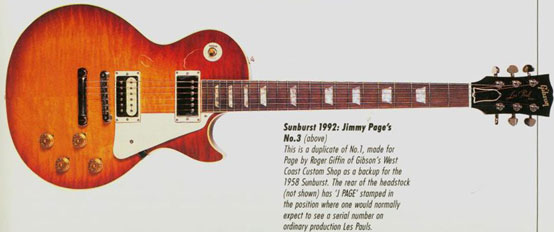
 This guitar was built for Jimmy Page's own personal use in 1991, and became the prototype for the Jimmy Page Signature Les Paul released in the '90's. This is not the same as the 2004, Tom Murphy-aged, line of Jimmy Page Signature guitars that were later built in the Nashville Custom Shop.
The guitar being replicated is a Les Paul Standard. You're probably dying to know if this is a replica of Jimmy Page's legendary #1 guitar. Well, here's the good news. It is!
On Roger's web site, there are a couple of pictures from this custom shop guitar including one of Roger, with a big cheesy grin on his face, playing #1 in the custom shop. Tony Bacon & Paul Day verify the guitar's history in "The Gibson Les Paul Book" (see below).
On the original guitar, the only major visible differences from a (very worn) stock guitar are the addition of two switches under the pick guard, for series/parallel and the other a phase switch and Grover machine heads. The neck is thick at the nut and at the neck heel, like a typical 1958 Les Paul, but it tapers to a super-slim depth in the middle. Page said that it was like that when he bought it, and he hasn't changed it.

| #1 has been modded many, many times by Jimmy Page over the years and there have been several configurations of "secret" switches. On the replica guitar, the switches have been changed to push/pull pots. In addition, the new guitar also has a compound radius fingerboard. There are some other features on this guitar that I am sworn to secrecy over (mostly in the electronics department), but they may be easy to figure out if you are familiar with guitar electronics. There are other features on the guitar that I simply can't remember. What's really annoying is that, as time passes, I am also forgetting which is which. Heh. It doesn't take very long to figure out this is no ordinary Les Paul or who this guitar belongs to. You just have to look at the serial number. |

| 
|
The Finished Guitar
Unfortunately, I don't have any pictures of the actual finished guitar. Once Roger had put the finishing touches on it, he whisked the guitar away in a cloud of secrecy and then reappeared some time later with a big smile on his face and no guitar. Fortunately, Tony Bacon & Paul Day managed to photograph the finished guitar for "The Gibson Les Paul Book."
Next Page: Top Luthier Secrets Revealed!